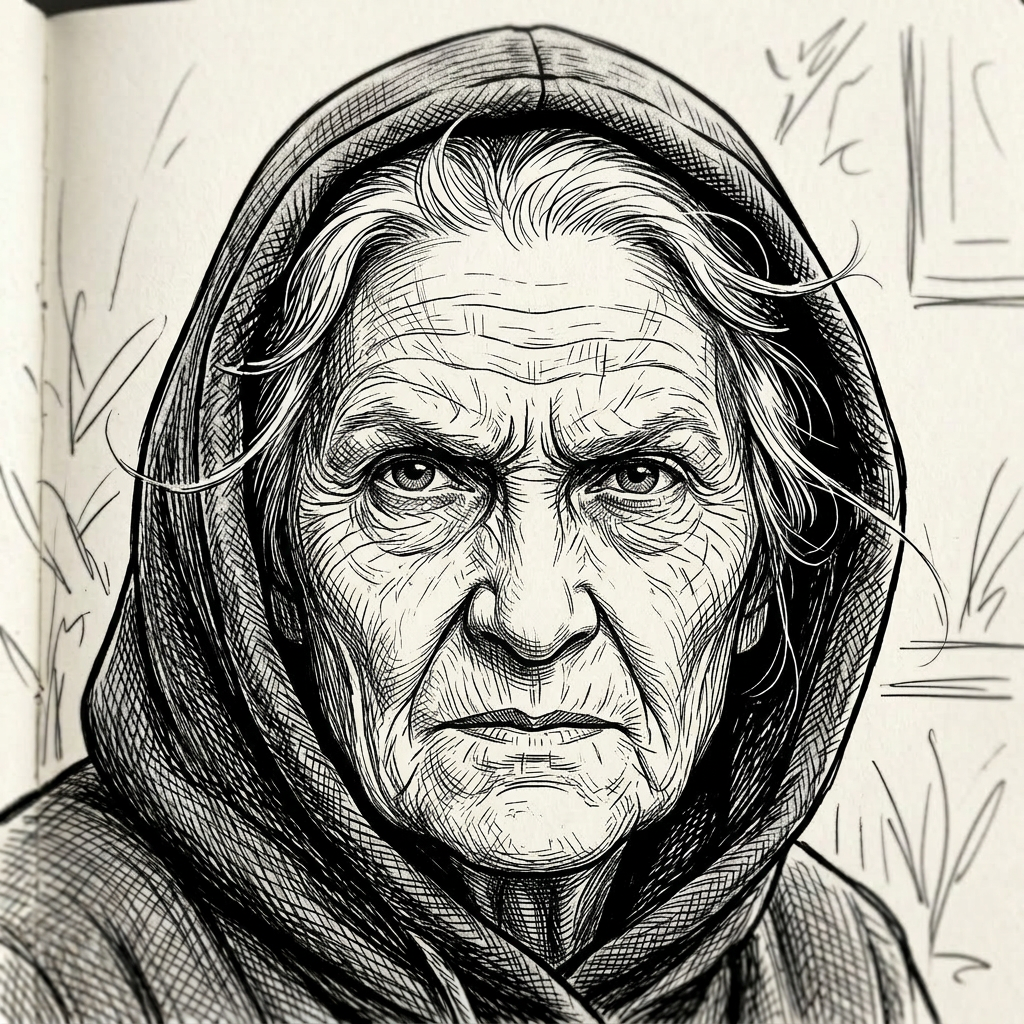
The old stone houses of the Sardinian village of Ghilosu seemed to hunch together in silence, as if sharing secrets that only the darkness understood. The chill of the autumn night crept in, winding through cobbled streets and empty fields. Moonlight settled over Ghilosu like a thin veil, washing the village in ghostly shades of silver and shadow.
Among the villagers, the air hung thick with fear. The year had been unkind; disease had arrived quietly and spread with ruthless efficiency, and families one by one watched loved ones wither away. Mothers wept as they clutched pale infants; sons sat hollow-eyed beside their ailing fathers. The silence of grief was broken only by the distant wails of the dying and the hurried whispers that everyone feared to speak aloud:
“The Accabadora comes in the night.”
The villagers knew her only by rumor and shadowed recollections. She was said to be an ancient woman who wandered from village to village, appearing only when someone was on the verge of death. She arrived unbidden, a specter dressed in black, her face obscured by a hood, and her eyes… some swore they were hollow, like the night itself had carved them out. She was the spirit of mercy—or so they tried to believe. But to others, she was something more sinister, something that lingered in dark corners, feeding off suffering and waiting for the dying moments to strike.
Chapter 1: The Summoning
Elena Sanna sat by the low-burning hearth in her home, hands trembling as she held the fevered hand of her husband, Nino. His face, once full of laughter and light, was gaunt and pale, his breaths coming shallow and labored. She felt the weight of his suffering in her own heart, and it clawed at her insides like a hungry beast.
Their children were asleep—or at least, she hoped they were. She had tucked them in, kissed them on their heads, but each knew in their silent way that something was wrong. That night, Elena had whispered a prayer to the Accabadora, a prayer filled with guilt and desperation, begging for her husband’s release from the agony that had plagued him for weeks. She had heard stories of people calling on her; some dared to say that if one wished hard enough, the Accabadora would hear and come.
As midnight approached, the air grew heavy and still, until even the crackling of the fire seemed muted. Elena felt a chill crawl down her spine, and as she looked up, a figure stood in the doorway—a cloaked woman in black.
Elena’s breath caught in her throat. She couldn’t see the woman’s face beneath the shadowed hood, but she could feel those hollow eyes watching her, assessing her plea.
“Are you…?” Elena whispered, her voice trembling.
The woman nodded slowly and moved soundlessly into the room. She walked to Nino’s side, her movements graceful and calm. Elena watched, frozen, as the Accabadora lifted a thin hand, skeletal in the dim light, and placed it on Nino’s forehead. He sighed, a soft sound of relief, and in that moment, Elena felt the unbearable weight of his suffering slip away.
When the Accabadora turned to her, Elena managed only a weak, “Thank you.”
The woman nodded once more before slipping into the night as silently as she had arrived. Elena knew that Nino’s spirit had departed, but the dread that filled her heart remained, as if a piece of darkness itself had seeped into her soul.
Chapter 2: The Whispering Fear
Word of the Accabadora’s visit spread through Ghilosu like wildfire. Some whispered in gratitude, others in fear. It was said she came only when summoned, that she never forced her will upon the living unless begged to do so. But the villagers’ whispers grew louder: if she came once, she would come again. The sickness that plagued Ghilosu wasn’t ending, and more villagers were taking to their beds, pale and feverish.
The priest, Father Tommaso, warned the villagers against summoning her. “To invite the Accabadora is to invite death itself into your homes,” he said during his sermons, his voice shaking with conviction. “You must place your faith in God alone, not in the shadows that linger.”
But his words went unheeded. Fear of endless suffering turned even the most faithful to whispers in the night, and soon enough, she appeared again. In each house she visited, the dying found peace, and the Accabadora left without a word. Her presence became an unspoken ritual, a dark sacrament that all knew yet dared not acknowledge.
For Elena, life grew darker still. Weeks passed since Nino’s death, but the shadow of the Accabadora loomed over her. She would see glimpses of black in the distance, or hear a whisper of cloth brushing against the stones outside her home. But whenever she turned, the street would be empty, and the silence would return.
One night, as she was sitting by the fire, the sound of faint footsteps echoed outside her door. Heart pounding, she peered through the window, but no one was there. A strange chill clung to the air, thick with the scent of earth and decay, and she hurried back inside, bolting the door.
The Accabadora, it seemed, had not finished her work in Ghilosu.
Chapter 3: Shadows in the Dark
As winter closed in, the illness claimed more lives, and every death seemed to pull the village deeper into despair. But one thing was different this time: people were starting to die even without asking for the Accabadora’s aid. Children found their grandparents dead in bed; husbands returned to find their wives gone, a cold stillness hanging in the air. The Accabadora was no longer summoned—she was coming of her own accord.
The village was gripped by fear, and even Father Tommaso found himself doubting his warnings. He had seen too many unnatural deaths, too many inexplicable occurrences. He resolved to confront her, to rid the village of her shadow once and for all.
Late one night, he made his way to the church, praying fervently as he lit the candles around the altar. His voice shook as he called out, “Accabadora, show yourself! If you are a spirit of mercy, prove yourself now. Show your purpose, or begone from this place!”
Silence met his words. But then, a flicker of movement caught his eye. He turned, heart pounding, as the candles dimmed, and there, standing in the shadowed corner of the church, was the Accabadora.
Her dark form was outlined by the faint light, her presence an oppressive weight that made it hard for him to breathe. She lifted a single, bony finger to her lips in a gesture of silence, and Father Tommaso felt the words die in his throat.
“Why do you bring death unbidden?” he forced out, though his voice was barely more than a whisper.
Her head tilted slightly, as if considering him, and in that moment he felt a deep, chilling understanding. She was not bound by mercy or summons any longer; she had come for the suffering that ran through Ghilosu itself, and she would not leave until every drop had been sated.
Father Tommaso fell to his knees as the Accabadora stepped forward. Her hollow eyes glimmered with an otherworldly light as she lifted her hand toward him.
Chapter 4: A Final Bargain
Days later, Father Tommaso was found dead in the church, his face frozen in a look of horror. The village was gripped by terror, and even those who had once whispered their thanks to the Accabadora now cursed her presence. They gathered at Elena’s home, desperate and afraid.
“We need to send her away,” one villager said, clutching her shawl tightly. “If she is no longer a spirit of mercy, then she must be banished!”
But none dared to speak the words aloud. Finally, Elena, who had been listening quietly, nodded. “I will go to her,” she whispered. “She took Nino when I asked, but now I must ask her to leave us in peace.”
Alone, Elena ventured into the hills that night, heart pounding as she climbed toward the old ruins where, according to legend, the Accabadora dwelled. The wind howled through the stones, and the cold was biting as she reached the peak.
There, silhouetted against the moonlight, was the cloaked figure of the Accabadora.
Elena’s voice trembled, but she forced herself to speak. “Please, leave us. You have taken enough. I beg of you, release us from this suffering.”
The Accabadora turned, and for the first time, Elena saw her face, an ageless mask, both ancient and ageless, hollow eyes boring into her soul. Elena fell to her knees, feeling the weight of lifetimes of suffering, pain, and sorrow pour into her mind.
But the Accabadora’s gaze softened, as if recognizing Elena’s plea. Slowly, the woman reached out, placing a single, cold finger on Elena’s forehead. In that touch, Elena felt the weight of the deaths the Accabadora had granted, the mercy and the horror bound together in a single dark act. And then, without a word, the figure faded into the night.
Epilogue
The following morning, the air in Ghilosu felt lighter, the sense of dread lifting as if it had been a bad dream. The villagers resumed their lives, the sickness faded, and the name of the Accabadora was spoken only in hushed tones, a story left to the past.
Elena, however, felt forever changed. She knew that while the Accabadora had left, her shadow lingered. She had glimpsed something that night—an understanding of death and mercy beyond what words could convey. And sometimes, when the night was especially dark and quiet, she would sense a faint presence at her side, a silent reminder that mercy and darkness could never be separated, for they walked hand in hand in the silence of the night.


Leave a Reply