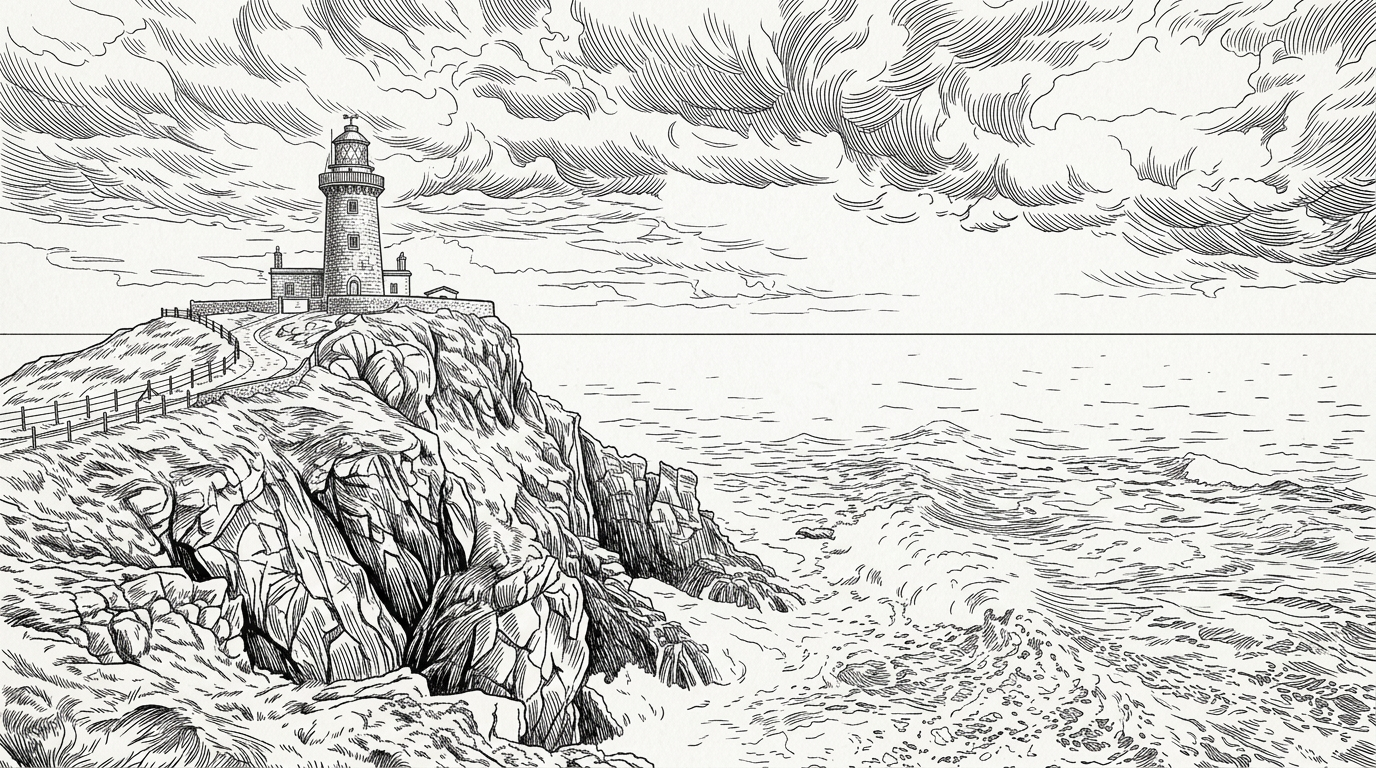
The storm came without warning.
One moment, the sky above Blackwater Point was streaked with lavender and gold; the next, a wall of black clouds tore the horizon in two. Captain Elias Crowe’s ship, The Wren, never stood a chance. By morning, the shore was littered with splintered timbers, torn canvas, and silence.
Mara Finch stood on the cliff that day, wind clawing at her hair, staring down at the foaming rocks where her brother’s body had been found. She was no sailor, but she knew the coast well—knew the hidden teeth of basalt that rose like knives from the sea, and how they waited in darkness for unwary vessels. She also knew that nothing marked this stretch of coast but rumor and fear.
In the weeks that followed, grief began to ferment into resolve. “If no one will warn them,” Mara told the townsfolk, “then I will.” At first, they thought it was madness—one woman, no money, no engineering skill, talking of building a beacon on a cliffside that even goats avoided. But Mara had a stubborn streak sharper than the rocks below.
She sold her late father’s tools, took work repairing nets and mending sails, and wrote letters to distant harbormasters asking for advice on lighthouse construction. From those replies came sketches and measurements: a spiral staircase of oak, a tower of stone thick enough to withstand the fiercest squalls, a lantern room fitted with a Fresnel lens that could throw its beam twelve miles out to sea.
Through the summer, the work began. Fishermen hauled stone up the cliff by pulley; children carried buckets of lime for mortar. The air smelled of seaweed and sweat. There were days when the wind nearly ripped the scaffolding apart, and nights when Mara sat by a lantern, fingers raw from rope burns, wondering if she had taken on too much.
By late autumn, the tower stood, squat and defiant against the gales. The final challenge was hauling the lens—its glass facets delicate as frost—up the winding stairs without shattering it. It took every able hand in the village, and even then, they moved at a pace slower than the tide. But when the last bolt was set, Mara lit the wick, and the beam leapt out across the black water like a sword of light.
Ships saw it that very night. A cargo brig altered course and passed safely into harbor. A fishing smack returned early, its captain raising his hat toward the cliff in salute.
The lighthouse never brought her brother back. But in the years to come, sailors called it the “Eye of Blackwater,” and spoke of how it saved lives in fog and fury. And when storms raged, Mara would stand inside the lantern room, watching the beam slice through the dark, knowing that for every vessel it reached, someone else’s grief might be spared.
 My Storytelling
Leave a comment