Author: Doug

  • The Lighthouse of Blackwater Point

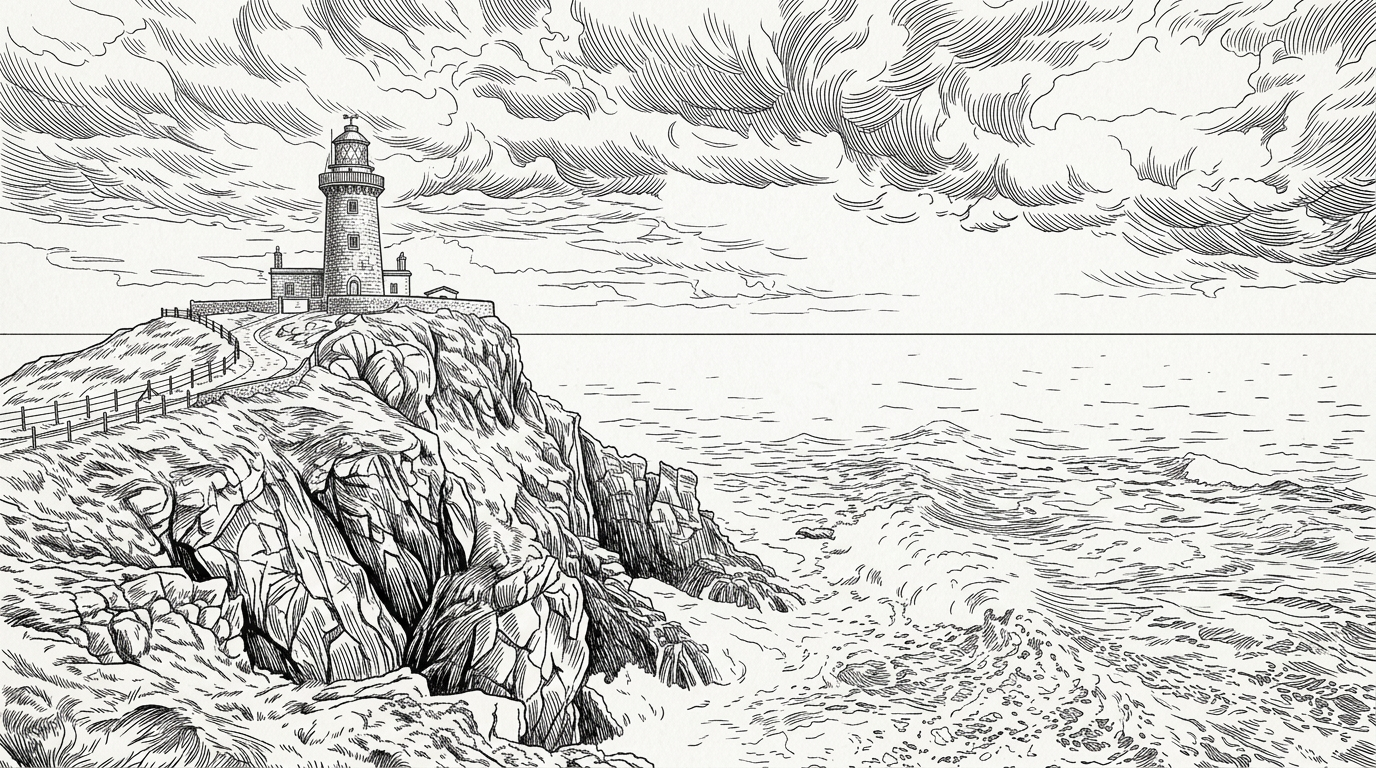
    Lighthouse on a cliff by stormy sea with crashing waves and dark clouds

    The storm came without warning.
    One moment, the sky above Blackwater Point was streaked with lavender and gold; the next, a wall of black clouds tore the horizon in two. Captain Elias Crowe’s ship, The Wren, never stood a chance. By morning, the shore was littered with splintered timbers, torn canvas, and silence.

    Mara Finch stood on the cliff that day, wind clawing at her hair, staring down at the foaming rocks where her brother’s body had been found. She was no sailor, but she knew the coast well—knew the hidden teeth of basalt that rose like knives from the sea, and how they waited in darkness for unwary vessels. She also knew that nothing marked this stretch of coast but rumor and fear.

    In the weeks that followed, grief began to ferment into resolve. “If no one will warn them,” Mara told the townsfolk, “then I will.” At first, they thought it was madness—one woman, no money, no engineering skill, talking of building a beacon on a cliffside that even goats avoided. But Mara had a stubborn streak sharper than the rocks below.

    She sold her late father’s tools, took work repairing nets and mending sails, and wrote letters to distant harbormasters asking for advice on lighthouse construction. From those replies came sketches and measurements: a spiral staircase of oak, a tower of stone thick enough to withstand the fiercest squalls, a lantern room fitted with a Fresnel lens that could throw its beam twelve miles out to sea.

    Through the summer, the work began. Fishermen hauled stone up the cliff by pulley; children carried buckets of lime for mortar. The air smelled of seaweed and sweat. There were days when the wind nearly ripped the scaffolding apart, and nights when Mara sat by a lantern, fingers raw from rope burns, wondering if she had taken on too much.

    By late autumn, the tower stood, squat and defiant against the gales. The final challenge was hauling the lens—its glass facets delicate as frost—up the winding stairs without shattering it. It took every able hand in the village, and even then, they moved at a pace slower than the tide. But when the last bolt was set, Mara lit the wick, and the beam leapt out across the black water like a sword of light.

    Ships saw it that very night. A cargo brig altered course and passed safely into harbor. A fishing smack returned early, its captain raising his hat toward the cliff in salute.

    The lighthouse never brought her brother back. But in the years to come, sailors called it the “Eye of Blackwater,” and spoke of how it saved lives in fog and fury. And when storms raged, Mara would stand inside the lantern room, watching the beam slice through the dark, knowing that for every vessel it reached, someone else’s grief might be spared.

  • A Salesman Called at My Door

    Man in business suit holding briefcase and folder standing at an open front door with welcome mat

    A salesman called at my door the other day, selling me something called “Self-Esteem.”

    He told me that everybody needed Self-Esteem and that I should try it. He claimed he knew many people who had it and that they were all happy, successful people. I wasn’t sure. I had never known I needed it, nor that I lacked it.

    “Do you have any Self-Esteem already?” he asked before leaving.

    I considered this seriously. I pictured my kitchen cupboards, the jars and tins neatly arranged. None of them, I realised, were labelled “Self-Esteem.”

    “No,” I said.

    He handed me a small jar.

    “Take this free sample. Try it today. If you like it, I’ll return tomorrow.”


    Later that day, I opened the jar and tasted the Self-Esteem.

    It was remarkable.

    I felt lighter. More certain. The world seemed to rearrange itself into something more manageable. I liked it immediately. By the evening, the jar was empty.

    The next morning, I found myself waiting for the salesman.


    He returned late in the afternoon.

    “I tried it,” I said. “I’d like more.”

    He smiled and offered me a full jar at a discounted price.

    I paid without much hesitation.

    At home, I sampled it again. The effect was just as strong—perhaps stronger. I felt capable of anything, though I did nothing in particular.


    The following week he returned.

    I had been careful, rationing it slightly, though not enough to prevent the jar from nearing empty. He suggested I take two jars this time. I agreed.

    After that, the pattern became familiar.

    Each week he returned. Each week I bought a little more. Sometimes two jars, sometimes three. The more I had, the less carefully I used it. I began taking it daily, sometimes several times a day.

    It always worked.


    One week, I ran out entirely before he returned.

    The absence was noticeable.

    Without it, things seemed less certain again. Smaller, perhaps. Or maybe I was.

    When he finally came, he explained that this was normal.

    “Self-Esteem is powerful,” he said. “It must be used carefully.”

    I accepted this and bought more.


    For some time, the arrangement continued.

    Then one day, a different salesman appeared.

    “My name is Tim,” he said. “I’ll be looking after you now.”

    The transition was smooth. Tim was friendly. Reliable. He knew my preferences. He offered similar deals. I continued buying without much thought.

    Later still, another arrived—Hal, who preferred to call early in the morning.

    “Best to start the day with it,” he explained.

    This seemed reasonable.


    Over time, I came to rely on these visits.

    The jars accumulated and emptied in steady rhythm. I rarely let myself run out, though it happened occasionally. Those moments were always unpleasant enough to correct the habit.


    Then one morning, there was a knock at the door on a day when no salesman was expected.

    It was an old friend.

    We had not seen each other in years, but recognised one another immediately. He came in, and we spoke as though no time had passed.

    At one point, he paused and looked at me carefully.

    “You haven’t changed,” he said.

    I laughed, though not entirely comfortably.

    “Not at all?” I asked.

    “Not really,” he said. “A bit older, of course. But otherwise the same.”


    That stayed with me.

    After he left, I looked around my home. It was as it had always been. My routines, my habits—unchanged. I thought about the weeks and months that had passed. The jars I had used. The visits I had waited for.

    I tried to recall what, exactly, had altered.

    I felt better, certainly. Often very much so.

    But beyond that—

    Very little seemed different.


    I considered, then, how much I had spent.

    On Tony. On Tim. On Hal. On the steady supply of something that made me feel improved, though it had altered almost nothing.


    There was still some left in the current jar.

    I looked at it for a long time.

    Then I placed it back on the shelf.

    Unopened.