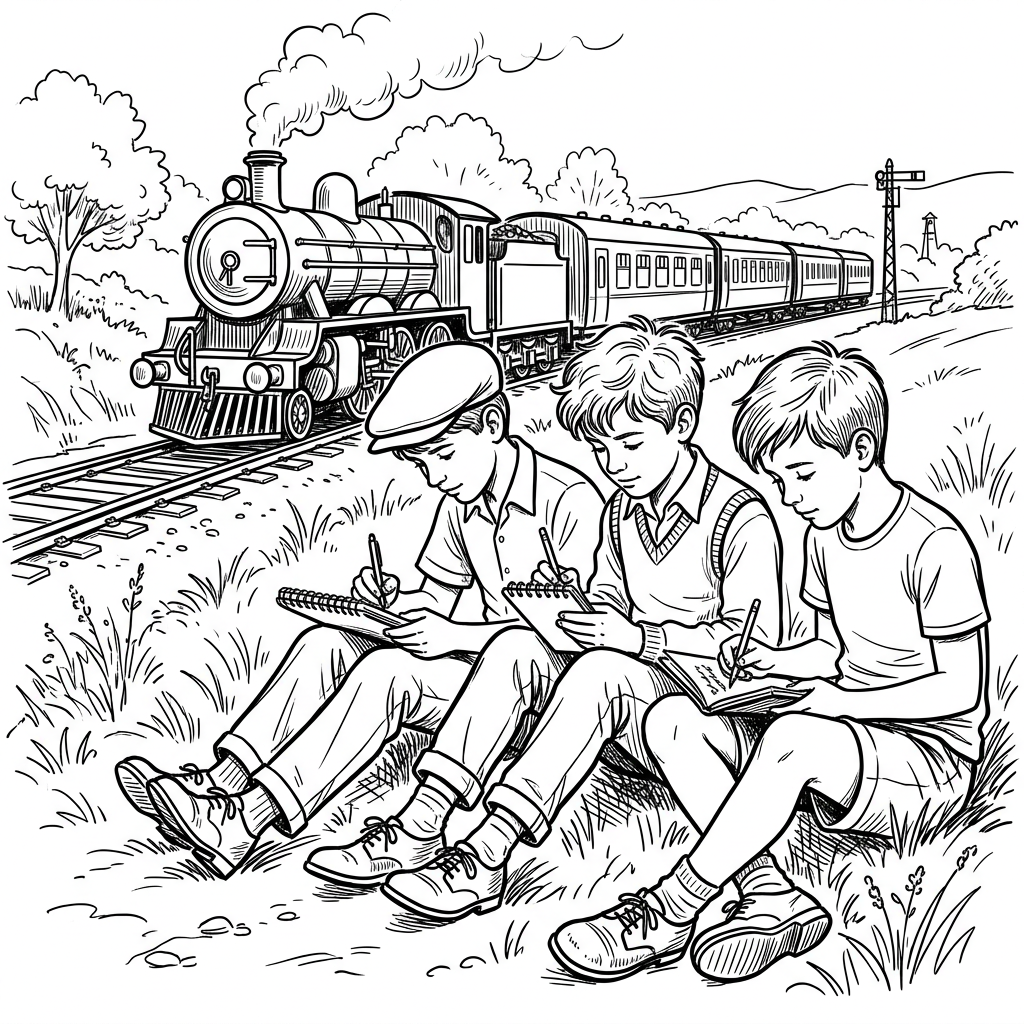
The last time I saw Paul, he was sitting on a railway line. “Hey, what are you doing?” I shouted. “Waiting for a train,” he replied. This seemed reasonable, so I left him there and moved on.
Paul and I had been friends back in our school days along with a mutual friend, Jeremy. We had been together during primary school and then on through secondary or high school.
The three of us, along with other classmates, Mark and another Paul, were all interested in trains. We were a dedicated group of gricers (that’s train spotters, to you). We’d often go to the local station with our notebooks and pencils, plus our trusted Ian Allen guide to spot and mark off as many new locos as we could.
In addition to our local station, we loved to visit London, especially London Paddington Station, where spotting was easy because the trains were usually stationary, or King’s Cross, where we could spot locos we rarely saw locally. Reading or Bristol were also great, as we might spot rarer locomotives on cross-country services.
Paul often seemed the keenest of us all when it came to trainspotting. He’d often be the first to suggest a trip to the station. Sometimes he even appeared to have a trip already planned in his head. It wasn’t until he got it fully planned out, with time, date, destination, and what we’d likely spot that he’d share it with the rest of us and ask us to tag along. We’d usually say yes; not always all of us, but usually Jeremy and I would tag along even if the others were less willing.
The object of these trips was to see as many new locos as we could and to mark them off in our guidebooks. Over time it became clear that Paul had marked off many more locos than the rest of us. So much so that we began to wonder if some trips he had done by himself or, more likely, he had marked many of the locos without actually seeing them, simply so that he could appear to be the top dog of all of us.
Paul was competitive like that. He always liked to think he was better than others or at least the best of our circle of friends.
This competitiveness, though, was to be Paul’s undoing. It all came to a head when we sat the school leaving exams; we all sat virtually in the same exams, and it was the grade and the number of passes that determined whether you progressed in the school, went to college, or were turfed out to join the workforce.
After the exams there was some waiting until the results were announced. It was an anxious time but also a relaxed time because the teachers were less concerned about your work, or even your attendance. Sure enough, Paul and some of the rest of us took time out to renew our hobby of trainspotting.
It was evident now, though, that the enthusiasm was waning for all of us except Paul. For us, other things in life had become more important.
The climax came on the first Saturday after the results had been announced. I, by chance, bumped into Paul.
“How many exams did you pass?” Was his opening greeting? “Everyone says they were hard this year.”
“Nine,” I replied, though I didn’t let on that I’d scraped through four or five of them. “What about you?” I asked, “How many did you pass?”
“Five,” he said. I found out later he was fibbing. He’d only passed four.
In those days. You couldn’t really hide your success or failure because the exam results were published in the local paper.
This marked the point where the lives of Paul, myself, and our friends, all diverged. Most of us stayed on at school to study for advanced exams, with some of us going on to university. Paul tried to retake his exams next year, but he couldn’t hack it and soon left school to join the local workforce. We learned that he had gotten a job in a local branch of a High Street chain store.
While I was still at school and then at university, news of Paul occasionally filtered down to me. I learned that he had gotten a girl pregnant, and while she had been prepared to have sex with him, she was not prepared to marry or even live with him. Later I learned that he had found another girl who had been prepared to marry him, but that they were getting through a divorce following the birth of their second child, Paul’s third. Then it was my parents who told me that they read in the local paper that Paul was serving time in jail for burglary and violence.
One time while I was visiting my parents, I bumped into Jeremy. He informed me that Paul had had some kind of breakdown after his time in jail and had been sent to a local institution. He was out again now, but none of his friends to still associated with him, as his behaviour had become completely unpredictable. There was only one thing Jeremy informed me that I’d recognise in Paul. He was still mad keen on trains and might often be seen at the station or one of the local bridges or somewhere along the line, spotting locomotives.
As fate would have it, the very next time I was in town visiting my parents. I went for a walk and passed under a local railway bridge; as I did so I was aware of someone above me. He seemed to be sitting on the railway line. It was clearly Paul. I watched him for a while, feeling uncertain whether to acknowledge him after all these years and all I’d heard about him, but then I decided to just risk it.
“Hey Paul, what are you doing?” I shouted.
“Waiting for a train,” he replied back, which seemed reasonable, so I left him and moved on.
That was the last I saw Paul. It seems his train turned up, but thankfully I was too far away to witness it.


Leave a Reply