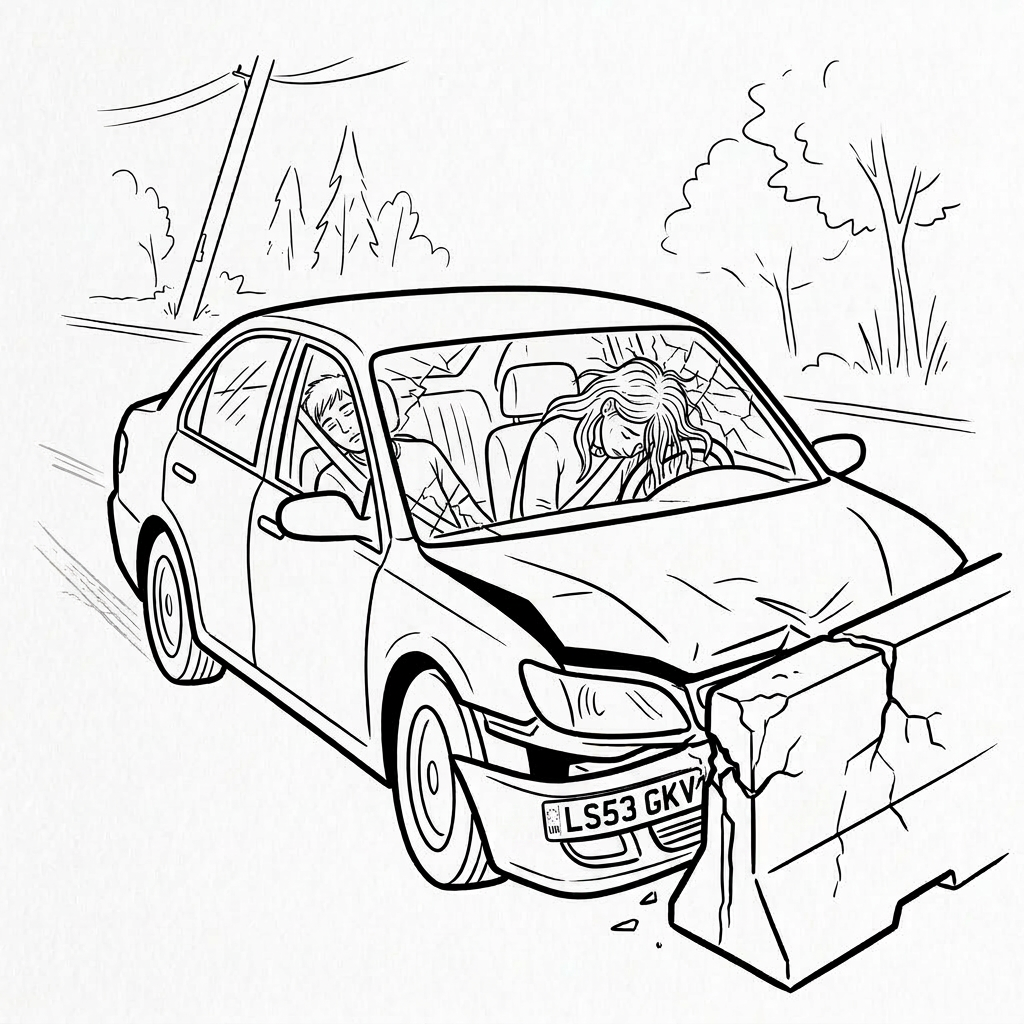
I lost my first fiancee in a car crash.
It does not take much imagination to realise how that would have had a devastating effect upon my life.
It was several years later that I started dating again. One of the people I met was a girl called Rachel. We met, I took her for a drink and a meal. Then I took her back to my place. At my place I was hoping for …. Well, you know what I was hoping for! She, however, wanted to talk. She wanted to talk about her last boyfriend.
It turned out that her last boyfriend had proposed to her while on a dinner date and she’d said yes. Both of them were feeling ecstatic and excited as they climbed onto his motorbike and started their journey home. They were so excited that they hardly gave attention to the road. The consequence of which was that he lost control of the motorbike, crashed ands died. Rachel sustained an injured leg but was otherwise physically survived.
She told me all this in her story and I sat there listening to her. Do you know though, to my shame, when she had finished, I had no idea what to say. The room was filled with an awkward silence.
Even though I had been through something similar; I still did not know what to say, what to do, or even how to respond to her. I was ashamed of myself; I felt a failure. In fact, I felt a failure as a human being.
You will not be surprised to hear that my relationship with Rachel went no further and lasted no longer. It was a total disaster apart from one thing; there was one good thing that arose out of this experience. I made a promise to myself that I would find out and learn how to respond in such situations, so that in the future I could avoid an embarrassing situation and also that I could be a positive benefit to the other person.
It was two years later when I was finally able to satisfy this promise. I had been invited to attend a training course to develop counselling skills. My teacher was a relationship counsellor called Christiana and her course was to become a ‘light-bulb’ moment in my life because it gave me my first insight into counselling.
I had been so energised and excited by her introductory course that I immediately signed up to study properly for a counselling qualification. A major part of the course was the study, practice and development of empathy.
Let me say at this point that I believe ‘empathy’ is possibly one of the misused and misunderstood words in the English language.
From the course, I learned that empathy is not ‘understanding’, not ‘compassion’ and not ‘sympathy’. Yet it is often used as a word when one of those other terms would be more correct. ‘Empathy’ sounds a more powerful and a more positive word than those other terms. Moreover, ‘empathy’ is not just about emotions and it involves much more.
What my training taught me is that empathy is not about putting yourself into someone else’s shoes. It is not about imagining how you would feel if you were in the same situation as someone else. This though, seems to be what many believe to be ‘empathy’.
Empathy is about seeing and experiencing the world through the eyes and senses of another person. It goes deeper even than that, though. It is also about interpreting and understanding those experiences though the point of view, or the philosophy, of the other person.
For empathy to exist, there needs to be communication between yourself and the other person. Furthermore, that communication needs to be in a ‘language’ you both comprehend and where there is agreement on the meaning of words used.
Consequently, you cannot be empathic with an animal, nor with a human baby. This does not mean you cannot be ‘understanding’ or ‘compassionate’ and ‘sympathetic’ but do not claim to be ‘empathic’.
The biggest barrier to empathy, apart from lack of communication, occurs when a person has been through a similar experience as the other person. I’ll let you read that last sentence again. It is often assumed that if you have been through the same or similar experience, it makes it easier to be empathic. The opposite is the case.
If you have been through a similar experience to the other person, you are likely to believe they will have had the same emotions, the same responses as you did. You risk projecting your emotions and responses onto the other person. In this way, you fail to experience the situation through the eyes and viewpoint of the other person. To be truly empathic, you need to put aside your experiences and emotions and to take on those of the other person.
Let me conclude by saying that empathy is a powerful tool which has positive benefits for all concerned. For me, I felt ashamed that I could not experience empathy when Rachel was telling me her story. I have no doubt that our relationship would have been more longer lasting and positive had I been able to do so. However, it was the shame that I felt at that time which led me to seek to improve myself.


Leave a Reply