• I lost my first fiancee in a car crash.
    It does not take much imagination to realise how that would have had a devastating effect upon my life.

    It was several years later that I started dating again. One of the people I met was a girl called Rachel. We met, I took her for a drink and a meal. Then I took her back to my place. At my place I was hoping for …. Well, you know what I was hoping for! She, however, wanted to talk. She wanted to talk about her last boyfriend.

    It turned out that her last boyfriend had proposed to her while on a dinner date and she’d said yes. Both of them were feeling ecstatic and excited as they climbed onto his motorbike and started their journey home. They were so excited that they hardly gave attention to the road. The consequence of which was that he lost control of the motorbike, crashed ands died. Rachel sustained an injured leg but was otherwise physically survived.

    She told me all this in her story and I sat there listening to her. Do you know though, to my shame, when she had finished, I had no idea what to say. The room was filled with an awkward silence.
    Even though I had been through something similar; I still did not know what to say, what to do, or even how to respond to her. I was ashamed of myself; I felt a failure. In fact, I felt a failure as a human being.

    You will not be surprised to hear that my relationship with Rachel went no further and lasted no longer. It was a total disaster apart from one thing; there was one good thing that arose out of this experience. I made a promise to myself that I would find out and learn how to respond in such situations, so that in the future I could avoid an embarrassing situation and also that I could be a positive benefit to the other person.

    It was two years later when I was finally able to satisfy this promise. I had been invited to attend a training course to develop counselling skills. My teacher was a relationship counsellor called Christiana and her course was to become a ‘light-bulb’ moment in my life because it gave me my first insight into counselling.

    I had been so energised and excited by her introductory course that I immediately signed up to study properly for a counselling qualification. A major part of the course was the study, practice and development of empathy.

    Let me say at this point that I believe ‘empathy’ is possibly one of the misused and misunderstood words in the English language.

    From the course, I learned that empathy is not ‘understanding’, not ‘compassion’ and not ‘sympathy’. Yet it is often used as a word when one of those other terms would be more correct. ‘Empathy’ sounds a more powerful and a more positive word than those other terms. Moreover, ‘empathy’ is not just about emotions and it involves much more.

    What my training taught me is that empathy is not about putting yourself into someone else’s shoes. It is not about imagining how you would feel if you were in the same situation as someone else. This though, seems to be what many believe to be ‘empathy’.

    Empathy is about seeing and experiencing the world through the eyes and senses of another person. It goes deeper even than that, though. It is also about interpreting and understanding those experiences though the point of view, or the philosophy, of the other person.

    For empathy to exist, there needs to be communication between yourself and the other person. Furthermore, that communication needs to be in a ‘language’ you both comprehend and where there is agreement on the meaning of words used.
    Consequently, you cannot be empathic with an animal, nor with a human baby. This does not mean you cannot be ‘understanding’ or ‘compassionate’ and ‘sympathetic’ but do not claim to be ‘empathic’.

    The biggest barrier to empathy, apart from lack of communication, occurs when a person has been through a similar experience as the other person. I’ll let you read that last sentence again. It is often assumed that if you have been through the same or similar experience, it makes it easier to be empathic. The opposite is the case.
    If you have been through a similar experience to the other person, you are likely to believe they will have had the same emotions, the same responses as you did. You risk projecting your emotions and responses onto the other person. In this way, you fail to experience the situation through the eyes and viewpoint of the other person. To be truly empathic, you need to put aside your experiences and emotions and to take on those of the other person.

    Let me conclude by saying that empathy is a powerful tool which has positive benefits for all concerned. For me, I felt ashamed that I could not experience empathy when Rachel was telling me her story. I have no doubt that our relationship would have been more longer lasting and positive had I been able to do so. However, it was the shame that I felt at that time which led me to seek to improve myself.

  • Not many of us will have seen a Leopard Eagle nor, indeed, have even heard of it but, at one time, it was widespread across the world from East Asia, through Southern Europe, parts of Africa and into North America. The ‘Leopard’ Eagle is so-called because of the dark spots against a golden brown plumage, which resembled the markings of the Leopard. There is a claim that the North American Leopard Eagle was a separate subspecies but this is something we may never know.

    It is something we may never know because the Leopard Eagle, having existed for centuries across the globe, is now reduced to just two known birds. These birds, both male, are kept in captivity in a South African zoo. Not only are they in captivity but they are also kept in secrecy. Only a few trusted people know which zoo keeps them, this is because the birds are still highly prized for their plumage among poachers, hunters and bird collectors.

    The story I want to tell you is part Native American folklore and part modern science. The folklore tells the story of the demise of the Leopard Eagle, while the science gives us hope for its possible return.

    The folklore story dates back to the days of the Anasazi. They were one of the first Native American tribes, who lived around the Colorado and Utah areas. For decades, the tribe had been lauded by environmentalists as an example of how Man could live in harmony with nature and the environment. However, as we have come to learn more about their society and their history, we realise that this was not the case; far from it.

    The Anasazi society was based upon wood. Just as our modern societies are based upon oil or fossil fuels, so the Anasazi relied upon wood. They used wood for building, for heating, for cooking and for many other purposes. The Anasazi, though, did not grow, gather or manage the wood themselves; they used other tribes to supply their wood for them. In this way, they saw the supply of their basic material as being something ‘beneath them’; something for other tribes to do for them.

    Obviously, supplying wood requires chopping down trees and, to the Anasazi, there seemed to be a limitless supply of trees. However, because they had outsourced their supply, they were unaware of how quickly their source was dwindling. Until it was too late.

    One consequence of the removal of trees, was the destruction of the natural habitat of the North American Leopard Eagle. The birds had naturally relied upon the trees to provide safe places for their nests. The loss of the trees meant the birds no longer had a place to build their large nests. However, the Leopard Eagle was more versatile than anyone might have guessed. As one natural habitat, the trees, was destroyed, the birds moved into and adapted to a new habitat. They built nests in caves and holes borrowed into the exposed sandstone cliffs.

    Native American folklore tells us that the descendant tribes of the Anasazi, the Pueblo Indians, followed the birds and also build their settlements into the rock face. Once again, though, the people and the birds found themselves in competition.

    However, we should not blame the Native people for the ultimate demise of the Leopard Eagle.

    The final decline of the North American Leopard Eagle came at the hands of hunters and sports shooters. For them, the Leopard Eagle was a favourite and a tempting target. Indeed, it became a badge of achievement to shoot a Leopard Eagle while it was in flight. The highest achievement was to shoot one with a single shot into the dark spot on the centre of its chest. It is believed the last North American Leopard Eagle was shot in 1963.

    Shooting, or hunting, also seems to have been the reason for the demise of the European Leopard Eagle. This was a much smaller and rarer bird, which was native almost exclusively to the Dolomites and Alps regions. It was especially prized by the Italian aristocracy, whom history now blames for the birds extinction.

    The Italians can also be blamed for starting the demise of the African Leopard Eagle. The bird, in flight, was often used a target practice by the Italian airforce during their invasion of Abyssinia (now Ethiopia) during the 1930s.

    The fate of the Asian Leopard Eagle is a lot less clear. No sighting of the Asian Leopard Eagle has been reported for over forty years and it is believed they are now extinct. We know the bird’s eggs were considered a ‘delicacy’ among several Asian cultures and it is possible the birds were hunted to extinction for food. Another culprit may have been defoliant chemicals, such as Agent Orange, used by US forces during the Vietnam war. The National Geographic Society has funded at least two expedition projects to try to find evidence of extant Leopard Eagles in Cambodia and Vietnam but without success.

    It is, therefore, believed that the two male birds kept secretly in a South African zoo are the last of the species.

    Which leads me to the second part of the story; how scientists are trying to give new life to the species.

    Genetic scientists, working with the South African zoo, are running a project to take DNA from the male birds and inject it into eggs. The intention is to give birth to live Leopard Eagle chicks.

    You may foresee a problem. We have only two birds known to be alive. Both of these are male, so how can we get eggs? There are still a few Leopard Eagle eggs, mostly in museums or in private collections. These are, however, totally unviable, being only empty shells.

    So the scientists have had to be ‘creative’ in their thinking and they have come up with a proposal to utilise eggs from a different bird. Originally, they had planned to use eggs from a related Eagle species. However this had to be abandoned as all eagle species are endangered and using eggs from a different member of the Eagle family would jeopardise the recover of that species.

    In the end, the project decided to utilise eggs from a different bird altogether. They decided to use duck eggs. This showed most promise as ducks, along with chickens, are one of few birds able to lay infertile eggs. Duck eggs also seemed closer in size to true Leopard Eagle eggs.

    To date, though, no Leopard Eagle chick has been successfully conceived. In most instances, the injected DNA failed to develop within the egg. In some cases, the resulting embryo was born dead and, in a few cases, the chick hatched from the egg was …. a duck!

    Nevertheless, the scientists remain both optimistic and determined, especially in light of the fact that a few of the dead embryos were quite clearly Leopard Eagle chicks. They, the scientists, just need to determine why they failed to thrive within the egg.

  • Exterior of The Old Bell Inn with wooden bench and bicycle

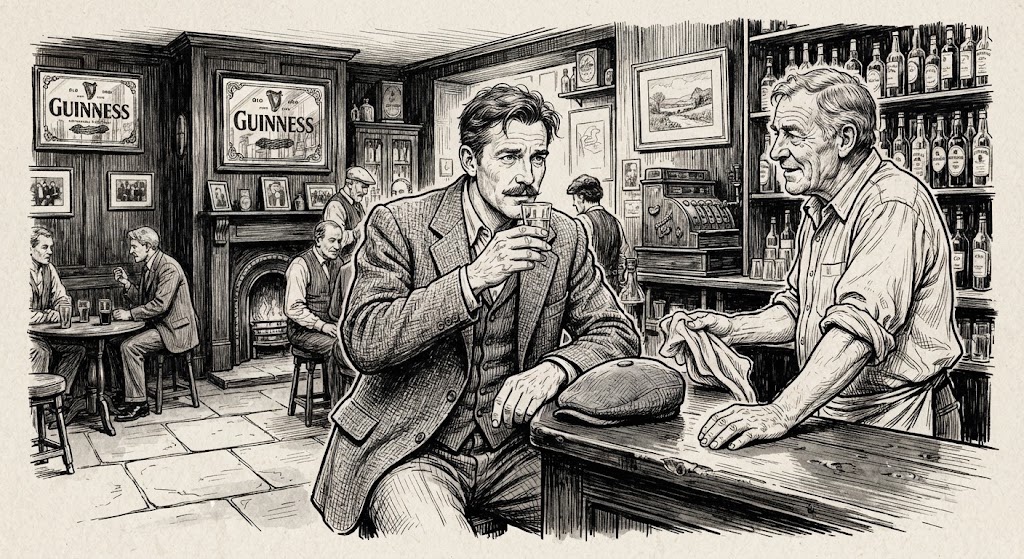
    Every day, straight after school, my mates and I would run to the pub.
    Not to get a drink, we were all underage and still in school uniform, but because that is where the nearest bus stop was.
    If we were lucky, we would catch the first bus, especially if it was running a little late or being held up in traffic.
    More often than not, we’d just miss it and have to wait for the next one, which was always packed with schoolboys.

    Just outside the pub was a bench, which also served as a seat for those waiting for a bus. We would all rush to sit on the bench, unless there was a member of the public already there. To be honest, there was not usually anybody, although, occasionally, we would find an old man sitting there. Not just any old man, but one particular man. Had we thought about it, we would have noticed sooner that he was there only on a Thursday.

    As a lad, I wasn’t always a good boy in school. I shall not tell you what I did, just to say that on that Thursday, I received a long detention after school. This meant that I was late getting to the bus stop. Being a Thursday, the old man was sitting on the bench, as usual. On this occasion, I did something unusual; I sat alongside him and introduced myself.

    He told me his name was Arthur and that he was waiting.
    He was not waiting for a bus, though, but for his wife.

    “How long have you been waiting?” I asked.
    “Several years.” He replied.
    I looked at him quizzically. I was not sure if this had been a joke or if I had simply misheard.
    “Well …” he said, in a way which let you know this was going to be a long explanation.

    Well, this is his story.


    One day, a Thursday, my wife and I came into town to do some shopping. I’ve always hated shopping and Mary, my wife, knew this. Usually, she would only ask me to come with her if we were buying something for the house, like a new carpet or paint, or if she had something heavy that she needed me to carry. I wasn’t sure why she had asked me to come with her this time.

    When we got to the pub, she surprised me by saying that I should stay here, have a pint or two while she went shopping, and then she’d meet me back here on the bench at four O’clock.

    Well, I wasn’t going to miss out on a chance like that, so I agreed. I went into the pub while she went shopping. But, I was having such a good time in the pub, drinking and chatting with other guys, that I failed to notice the time. When I did look at the clock above the bar, it was just gone half past four.

    Quickly, I finished my drink and stepped outside. I looked at the bench and there was nobody there. ‘Phew’, I thought, it must be taking her longer to do the shopping. So I sat down and waited.

    “Hey, isn’t that your bus?” Arthur said.

    “Don’t worry, I’ll catch the next one. I want to hear more of your story” I replied.

    Well …

    I waited here on this bench until after five thirty. That’s when the shops started closing, but she still had not arrived back.
    By now, of course, I was starting to worry; perhaps something had happened to her, an accident, maybe.
    So I started to walk along the High Street to see if I could spot her.
    There were certain shops that I knew she liked to go in, and I stopped outside each of those. I was trying to look inside but, of course, each one was closed.

    I walked the length and breadth of the High Street and ended up back at this bench. But, I didn’t see her anywhere.

    Then the thought occurred to me that perhaps she had arrived back at four o’clock and had got tired of waiting for me. Perhaps she had got the bus back home without me.

    If that was true, then I knew I was in a lot of trouble and would have some explaining to do. So, there was nothing for it but to catch the next bus and try to think of a convincing story on the way home.

    The trouble was, when I got home, she wasn’t there. Everything was still exactly the same as it had been when we left it.

    By then, I was convinced something bad had happened, and I was worried sick.

    Don’t ask me why, but the first thing I did was to get a bus back to the high street again and came to this bench.
    I don’t know what I was thinking, but, of course, she still wasn’t there.
    I popped into the pub and asked the barman if he had seen her come into the pub at any time, perhaps she had been looking for me.
    But he said no.

    Finally, I caught a late bus home.

    The following Thursday, I was again late leaving school, not because of any detention; I simply wanted to wait around so that I could meet Arthur once more and ask for more of his story.
    When I got to the bus stop, all the other schoolboys had already gone, but Arthur was still there sitting on the bench.

    We exchanged greetings and I told him I was dying to hear the rest of his story.

    Well … he continued.

    I spent all that first evening and the night worrying about her. Then, first thing in the morning, I called the police; I don’t know why I had not done that sooner.

    They asked me lots of questions; had we had an argument? Had she been acting strangely, did she have any illnesses, had I called her parents or friends? Looking back, they were all sensible questions, but it annoyed me because all I wanted was for them to start looking for her.

    Do you know what they told me? They told me they couldn’t start looking for her until Monday. Three days later, for goodness’ sake,… she could have been dead by then!

    They did have one good suggestion, though; ring the hospital. Which I hadn’t thought of doing.
    So afterwards, I did ring the local hospital, But they told me that nobody with Mary’s name had been admitted.
    I even rang the pub again, and I rang our bank. The pub hadn’t seen her, and the bank said no money had been taken out of our account by her.

    The police did come round at some time that weekend. They wanted a better description and a recent photo of her. I guess they were trying to get everything ready for when they started looking for her. They may have been trying to reassure me but, in effect, it made me more anxious because it seemed to make it all the more real, that something bad had happened.

    Each day that week and the week after, I rang the police station to see if they had found anything about her. Each day… nothing.

    At one point, a reporter from the local paper came round. He wanted to write a story about her. But, his article finally appeared somewhere at the bottom of the page, somewhere inside the paper. Somewhere, nobody would have noticed it!

    Then, eventually, and I don’t know why, it came round to Thursday, and, I decided to go visit this bench again. As I say, I don’t know why, I guess I just hoped she might be here.
    It was a strange idea, but it was all I had at the time. So I came here just before four o’clock to wait for her.
    The next Thursday, I did the same. And the Thursday after that, and the next one. Until it became almost a routine. Maybe, ‘ritual’ is a better word.

    I come here every Thursday, just to remember her. Perhaps, there’s still a little hope that she might return.

    For many weeks, I’d meet and talk with Arthur at the bus stop. I’d ask him if he had any news of his wife.
    Each week, it was the same; nothing.

    It was a pity I’d met Arthur during my last year at school. With the long summer holiday and then going in to work, I lost touch with him.

    You remember, I told you that I wasn’t always a good boy at school?
    Well, it wasn’t just as a schoolboy, as a youth and a young adult, I also wasn’t always good.
    I shan’t reveal what I did wrong but, several years later, my punishment was to do ‘Community Service’.

    As chance would have it, part of my community service was spent helping out at an old people’s home.

    I had been there a couple of days before I saw someone who looked familiar. It was Arthur. This was where he was now living, and he was sitting alone in the lounge.
    So, I went up and introduced myself to him. I was surprised that he seemed to recognise and recall me almost straight away.
    “You’re that nice young man who listened to my story on the pub bench.” He said.

    “That’s right,” I said, “Did you ever find out what happened to your wife?”
    “You wouldn’t believe what happened.” He said.
    “Tell me…”

    “Well …”

    One day, many years after Mary disappeared, there was a knock on my front door. Well, actually, he rang the doorbell, but you know what I mean.
    He was a nice, well-dressed, young man in his twenties. I thought he was either a salesman or a Jehovah’s witness, or something like that.
    But straightaway, he knew my name and asked if I’d been married to Mary.
    I said ‘yes’, of course.
    Then he said, and I’ll never forget this, he said he had some important news for me.
    “Don’t tell me,” I said, “Jesus loves me.”

    “Maybe he does,” he said, “no it’s nothing like that. I’m not here to convert you to any religion.”

    It was then that he told me he was my son.

    That made me very angry and a little frightened. Mary and I had tried to have children but, for some reason, we found we couldn’t.
    Now this strange man was claiming to be my son.

    He told me that this mother had told him that she didn’t think his father was his real father. His mother had been married to someone else, technically they were still married, but they had been unable to have children. His mother had started having an affair with another man, his father, and she found out she was pregnant. Naturally, she assumed that father was the man she had been having this affair with.
    So she left her husband and moved in to live with her lover so that they could bring up their child together.

    As her son grew up, his mother began to have doubts. In her son, she could see traits of her real husband and very little, if anything, of her new partner. But, by then, it was too late to do anything about it.
    He, this man, went on to explain that his mother promised him on his 21st birthday, that he had the right to know who his real father was.
    It turns out that they arranged, somehow, to have a DNA test. It turned out that the man was not related to the man he thought was his father.

    I must admit, I found this all a bit confusing and troubling, so I asked the man what his mother’s name was. He said Mary and that he was called Chris.

    It turned out that Mary was actually pregnant with my son when she disappeared.

    As you can imagine, I had lots of questions I wanted to ask Arthur; like ‘did he and Mary ever get back together?’ ‘Does he still see his son?’ ‘How does he feel toward his wife and her new partner?’

    But all my questions would have to wait because, by this time, my Community Service Supervisor had spotted me sitting and chatting with Arthur. He came in and moved me on. I was also barred from talking to Arthur, or any other resident of the home, for the rest of my time there.

    As it turned out, it was some 3 months later that I was allowed to see Arthur again. I learned that he had still not seen Mary since her disappearance, but his son, Chris, did visit him once a month.

    A few years ago, I attended Arthur’s funeral. It was there that I met Chris myself. It was Chris who first suggested that I should tell Arthur’s story.
    That, I have just done.